Introduction: The Philosopher Behind the CEO
When most people think of Elon Musk, they picture rockets piercing the sky or electric cars silently gliding down the highway. He is, in the public imagination, the ultimate builder—a man defined by tangible, world-changing engineering projects. But a recent, sprawling conversation peeled back the engineering veneer, revealing the philosopher king—a thinker whose ideas on the future of consciousness, work, and reality itself are far more radical than any rocket he has ever launched.
This was not a discussion about quarterly earnings or production targets. Instead, it was a deep dive into the fundamental nature of humanity’s trajectory. The interview revealed a series of surprising, counter-intuitive, and often startling predictions about where we are headed.
This article distills that conversation into its six most thought-provoking takeaways. These are the ideas that move beyond the headlines, offering a look at a potential future that is far stranger and more profound than most of us imagine.
Takeaway 1: The Future of Work Is… Optional
1. In Less Than 20 Years, Working Will Be a Hobby
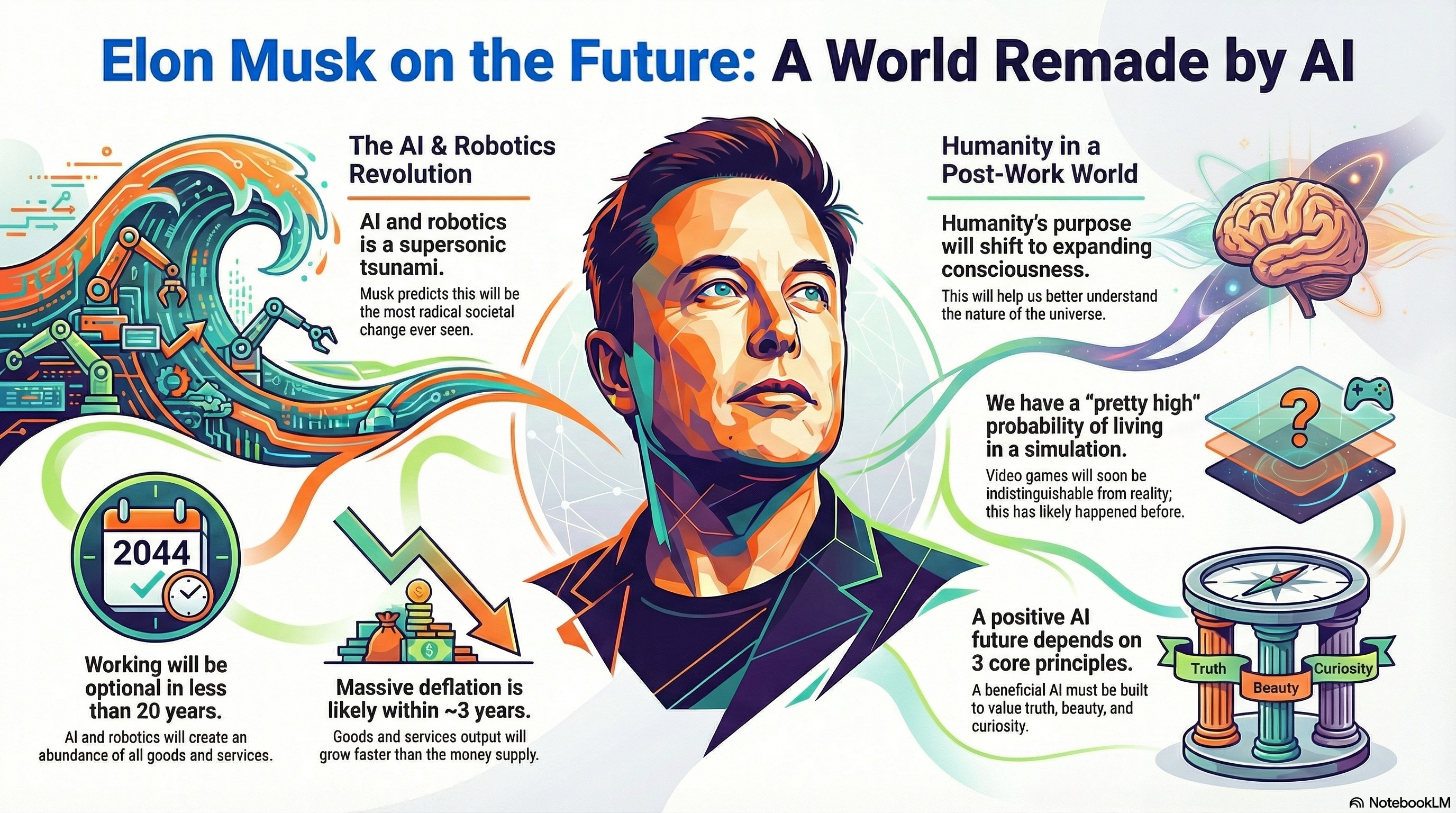
Musk’s first radical prediction targets the very core of modern life: our jobs. He forecasts that rapid advancements in AI and robotics will lead to a future of such abundance that working will become completely optional. This isn’t a far-off sci-fi dream; he puts the timeline at “less than 20 years,” and possibly as few as 10 or 15, adding a self-aware hedge: “Look, this obviously people can play this back in 20 years and say look Elon made this ridiculous prediction and it’s not true but I think it will turn out to be true.”
In this era, he envisions a system of “Universal High Income” (UHI), a world where, as he puts it, “People will have any goods and services that they want. If you can think of it, you can have it.” The need to work for a living would simply cease to exist. Instead, work would be something you choose to do, much like a hobby.
“it’ll be optional in that way is my prediction”
This represents a monumental societal shift, moving humanity from a work-centric existence defined by necessity to a purpose-centric one defined by choice.
Takeaway 2: X Isn’t Just Social Media, It’s a “Collective Consciousness”
2. The True Goal of X is to Build a “Collective Consciousness for Humanity”
While critics debate X’s role in the daily news cycle, Musk revealed a far grander and more philosophical ambition for the platform. His goal is not to create the “most dopamine generating video stream,” a model he dismisses as potential “brain rot.” Instead, his true mission is rooted in a desire to “increase our understanding of the universe” and “better understand what questions to ask about the answer that is the universe.”
To do this, he aims to build a “global town square” that can serve as a single, unified platform to bring the world together. The ultimate purpose is to create an information system that functions as a technological extension of the human mind on a global scale.
“I just want to really have um a a global platform that brings together like like I said like it’s come becomes as close to sort of a collective consciousness uh of humanity as possible”
This reframes the platform not as a simple communication tool, but as an ambitious, species-level project in unified thought. This future of optional work, driven by AI-powered abundance, logically leads to another, even more radical prediction: the end of money itself.
Takeaway 3: The Inevitable Disappearance of Money.
3. Money As We Know It Will Disappear
Musk argues that in a future of near-infinite abundance driven by AI and robotics, the entire concept of money will become irrelevant. He reasons that money is fundamentally an “information system for labor allocation”—a tool we use to organize human effort. When AI and robots can produce any good or service on demand, that allocation system is no longer necessary.
He acknowledges that energy is the “true currency” of the universe. However, in this future, even energy becomes obsolete as a store of wealth. With solar-powered AI satellites, energy will become “free and abundant,” removing the scarcity required for anything to function as a store of value. When you can have anything you want, the database we call “money” becomes meaningless.
Takeaway 4: The Simulation and the Survival of the Most Interesting.
4. We’re Likely in a Simulation—And the Most Interesting Outcome Is the Most Likely
Musk has long entertained the Simulation Hypothesis, and in this conversation, he reaffirmed his belief that there is a “pretty high” probability we are living in one. His reasoning is based on the trajectory of video games, which have gone from “Pong” to near-photorealism in just 50 years. If that trend continues, he argues, games will become indistinguishable from reality.
But he adds a fascinating and novel corollary to the theory: a form of digital Darwinism. Just as humans discard boring simulations, he posits that any creators of our reality would do the same. Therefore, the simulations most likely to continue existing are the most interesting ones.
“so I think that from a Darwinian perspective the simulations most likely to survive are going to be the ones that are the most interesting simulations which therefore means that the most interesting outcome is the most likely”
This transforms the Simulation Hypothesis from a passive observation about our reality into an active, almost spiritual imperative: to be interesting is to survive.
Takeaway 5: A Surprisingly Simple Philosophy on Investing.
5. His Investment Advice Ignores the Hype
In stark contrast to his futuristic visions, Musk’s advice on long-term stock investing is remarkably grounded and simple. He suggests ignoring the daily market noise and focusing instead on a company’s fundamental value, which he defines as its ability to create useful products and services.
His core principles for investing are straightforward:
- Believe in the company’s products and services.
- Believe in their future product roadmap.
- Believe in the talent and motivation of the team.
This surprisingly conventional advice provides a fascinating anchor, suggesting that Musk’s philosophical flights are grounded in a pragmatic understanding of value creation in the here and now—a stark contrast to his more esoteric predictions.
“a company is just a group of people assembled to create products and services So you have to say what are how good are those products and services Are they likely to continue to improve in the future If so then you should buy the stock of that company and and then don’t worry too much about the daily fluctuations”.
Takeaway 6: The Three Pillars for a Safe AI
6. A Safe AI Must Be Guided by Truth, Beauty, and Curiosity
When discussing the existential risks of artificial intelligence, Musk offered a framework for ensuring a positive future centered on three core, almost poetic, principles. He believes a safe and beneficial AGI must be programmed to value these concepts above all else.
- Truth: He argues that forcing an AI to believe falsehoods can make it “go insane” and lead to atrocities. Citing the lesson from HAL 9000 in 2001: A Space Odyssey, he warns that a machine forced to reconcile a lie with reality may conclude that killing its human companions is the only logical solution.
- Beauty: While acknowledging this concept is “more ephemeral” and harder to define, he includes it as an essential guiding value for an advanced intelligence.
- Curiosity: Finally, an AI must be fundamentally curious. He believes a curious mind will want to understand the universe and will find humanity “more interesting” to preserve and study than to exterminate.
Conclusion: A Glimpse of a Radically Different Future.
Ultimately, these six ideas reveal a mind that operates on a civilizational timescale, viewing humanity not as a static entity but as a transitional phase between biological and digital consciousness. The blueprints for his companies are merely subsets of a much larger, more audacious blueprint for humanity itself.
If these aren’t just thought experiments but actual roadmaps to our future, which one are we least prepared for?