
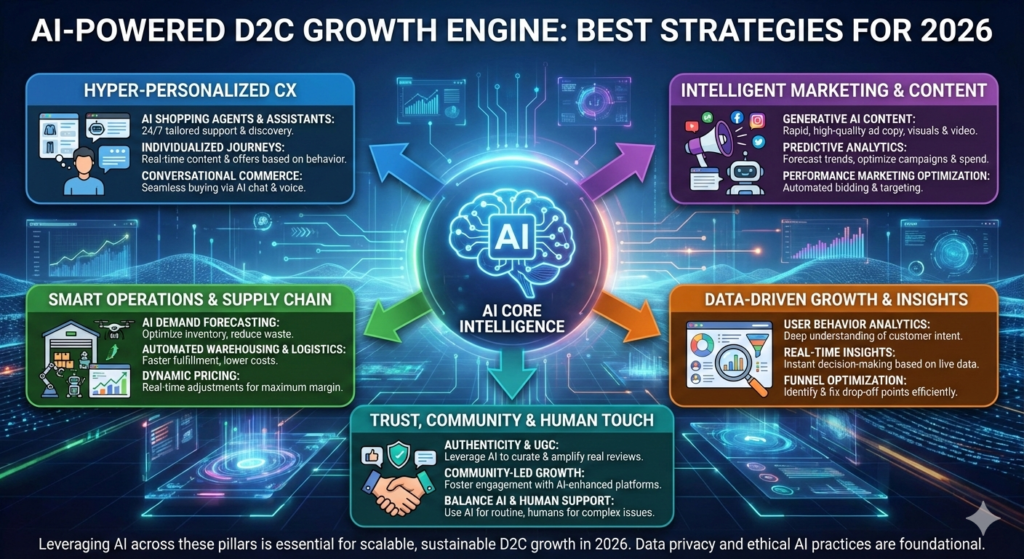
The direct-to-consumer landscape is evolving at breakneck speed, and 2026 promises to be a watershed year for brands that embrace artificial intelligence strategically. As consumer expectations rise and competition intensifies, AI has transitioned from being a competitive advantage to an absolute necessity for D2C brands looking to scale efficiently and sustainably.
Understanding the D2C Landscape in 2026
The D2C market has matured significantly, with consumers now expecting personalized experiences, instant gratification, and seamless interactions across all touchpoints. Traditional growth tactics like broad-stroke advertising and generic email campaigns are delivering diminishing returns. Meanwhile, AI technologies have become more accessible, affordable, and powerful, creating unprecedented opportunities for brands of all sizes to compete with enterprise-level sophistication.
The convergence of generative AI, predictive analytics, and automation technologies has fundamentally changed what’s possible for D2C brands. Companies that strategically deploy AI across their operations are seeing 3-5x improvements in customer acquisition efficiency, 40-60% increases in customer lifetime value, and significant reductions in operational costs.
The AI-Powered D2C Growth Framework
Building a successful AI-driven D2C strategy requires a holistic approach that touches every aspect of your business. The following framework provides a comprehensive roadmap for leveraging AI to accelerate growth in 2026.
1. Hyper-Personalized Customer Experience
Personalization has evolved far beyond inserting a customer’s first name in an email. In 2026, successful D2C brands are using AI to create truly individualized experiences that adapt in real-time to customer behavior, preferences, and intent signals.
AI-powered recommendation engines now analyze hundreds of data points including browsing behavior, purchase history, social media activity, time of day, device type, and even weather patterns to deliver product suggestions that feel almost telepathic. These systems continuously learn and improve, becoming more accurate with every interaction. Brands implementing advanced personalization engines are seeing conversion rate increases of 25-40% compared to traditional approaches.
Dynamic website personalization takes this further by automatically adjusting homepage layouts, product displays, messaging, and even pricing based on individual visitor profiles. A first-time visitor might see educational content and trust signals, while a returning customer sees personalized product recommendations and loyalty rewards. This level of customization was once only possible for enterprise brands with massive technology budgets, but AI platforms have democratized access to these capabilities.
Conversational AI and chatbots have also matured dramatically. Modern AI assistants can handle complex customer service inquiries, provide detailed product recommendations, process returns, and even upsell complementary products with natural, human-like conversations. These systems operate 24/7 across multiple channels, providing instant support that today’s consumers demand while reducing customer service costs by 30-50%.
2. Intelligent Customer Acquisition
Customer acquisition costs continue to rise across all digital channels, making efficiency paramount. AI is revolutionizing how D2C brands identify, target, and convert potential customers.
Predictive audience modeling uses machine learning to analyze your existing customer base and identify patterns that distinguish your best customers from the rest. These models can then scan millions of potential customers across advertising platforms to find lookalike audiences with the highest probability of conversion. This approach typically reduces customer acquisition costs by 20-35% while improving customer quality.
AI-powered creative optimization automatically tests hundreds of ad variations across different audiences, continuously learning which combinations of images, copy, headlines, and calls-to-action perform best. Instead of running manual A/B tests that take weeks, AI systems can optimize campaigns in real-time, shifting budget to winning combinations within hours. Brands using AI creative optimization report 50-80% improvements in ad performance.
Programmatic advertising platforms enhanced with AI can make thousands of bidding decisions per second, automatically allocating budget to the channels, placements, and audiences delivering the best return. These systems consider time of day, competitor activity, inventory levels, and conversion likelihood to maximize every dollar spent.
3. Content Creation and Marketing at Scale
Content remains king in D2C marketing, but creating high-quality, engaging content consistently has always been resource-intensive. AI is changing this equation dramatically.
Generative AI tools can now produce blog posts, product descriptions, social media content, email campaigns, and even video scripts at scale while maintaining brand voice and quality standards. While human oversight and editing remain essential, AI can reduce content creation time by 60-70%, allowing small teams to compete with much larger organizations.
AI-powered SEO tools analyze search trends, competitor content, and ranking factors to recommend topics, keywords, and content structures that maximize organic visibility. These tools can even generate SEO-optimized content outlines and first drafts, dramatically accelerating your content marketing engine.
Social media management platforms enhanced with AI can analyze engagement patterns to recommend optimal posting times, predict which content will resonate with your audience, and even generate caption variations tailored to different platform algorithms. Some advanced systems can create multiple versions of the same content optimized for Instagram, TikTok, Facebook, and LinkedIn automatically.
Video content, which typically requires significant production resources, can now be created using AI video generation tools that can produce product demonstrations, customer testimonials, and explainer videos from simple text prompts or existing product images.
4. Data-Driven Inventory and Supply Chain Management
Inventory management can make or break D2C profitability. Too much inventory ties up capital and leads to markdowns, while too little means lost sales and disappointed customers. AI brings unprecedented precision to this challenge.
Demand forecasting powered by machine learning analyzes historical sales data, seasonality patterns, marketing campaigns, weather, economic indicators, and even social media trends to predict future demand with remarkable accuracy. These systems can forecast at the SKU level, accounting for size, color, and regional variations, allowing brands to optimize inventory levels and reduce carrying costs by 20-30%.
Dynamic pricing algorithms adjust product prices in real-time based on demand signals, competitor pricing, inventory levels, and margin targets. This allows brands to maximize revenue during high-demand periods while using strategic discounts to move slower products efficiently.
Supply chain optimization using AI can predict and prevent disruptions, recommend optimal supplier mixes, and identify the most cost-effective shipping routes and methods. Brands using AI supply chain tools report 15-25% reductions in logistics costs and significant improvements in delivery times.
5. Predictive Analytics and Customer Retention
Acquiring a new customer costs 5-7 times more than retaining an existing one, making retention a critical growth lever. AI enables proactive retention strategies that identify at-risk customers before they churn.
Churn prediction models analyze customer behavior patterns to identify early warning signs that someone may be losing interest or considering switching to a competitor. These signals might include decreased website visits, longer time between purchases, reduced email engagement, or changes in browsing behavior. Brands can then trigger targeted retention campaigns offering personalized incentives, exclusive content, or proactive customer service outreach.
Lifetime value prediction helps prioritize which customers deserve the most attention and investment. AI models can predict with increasing accuracy which customers will become high-value repeat buyers versus one-time purchasers, allowing you to segment your marketing spend and customer service resources appropriately.
Next-best-action engines use AI to recommend the optimal next step for each customer at every stage of their journey. This might be a product recommendation, an educational email, a discount offer, or an invitation to join your loyalty program. These systems consider hundreds of variables to determine which action is most likely to advance the customer relationship.
6. AI-Enhanced Customer Service and Support
Customer service is often the most labor-intensive part of running a D2C brand, but it’s also critical to retention and word-of-mouth growth. AI is transforming customer support from a cost center into a growth driver.
Intelligent routing systems analyze incoming customer inquiries and automatically direct them to the most appropriate resource, whether that’s a self-service knowledge base article, a chatbot, or a human agent with specific expertise. This reduces resolution time and improves first-contact resolution rates.
Sentiment analysis tools monitor customer interactions across all channels, identifying frustrated or unhappy customers who need immediate attention. These systems can escalate high-priority issues automatically and even recommend specific solutions based on similar past cases.
Automated ticket summarization and response suggestions help human agents work more efficiently by providing instant context and recommended solutions for common issues. This can increase agent productivity by 30-40% while maintaining or improving service quality.
Implementing Your AI Strategy: A Practical Roadmap
| Phase | Timeline | Key Actions | Expected Outcomes |
|---|---|---|---|
| Assessment | Weeks 1-2 | Audit current tech stack, identify pain points, benchmark performance metrics | Clear understanding of opportunities and gaps |
| Quick Wins | Weeks 3-6 | Implement chatbot, basic personalization, email automation | 10-20% improvement in efficiency, immediate ROI |
| Foundation Building | Months 2-4 | Deploy predictive analytics, advanced segmentation, content AI tools | 25-35% improvement in marketing efficiency |
| Advanced Optimization | Months 5-8 | Implement dynamic pricing, demand forecasting, full personalization | 40-60% overall performance improvement |
| Continuous Innovation | Ongoing | Test emerging AI tools, optimize models, expand use cases | Sustained competitive advantage |
Essential AI Tools for D2C Brands in 2026
The AI technology landscape can be overwhelming, but several categories of tools have proven essential for D2C success. Customer data platforms with AI capabilities serve as the foundation, unifying customer data from all sources and enabling personalized experiences. Marketing automation platforms enhanced with AI handle email, SMS, and push notification campaigns with intelligent timing and content optimization.
E-commerce personalization engines integrate with your website to deliver dynamic recommendations and customized experiences. Conversational AI platforms power chatbots and virtual assistants across your website, social media, and messaging apps. Content generation tools assist with creating marketing copy, product descriptions, and social media posts at scale.
Analytics and business intelligence platforms with AI provide predictive insights and automated reporting. Ad optimization platforms use machine learning to improve campaign performance across channels. Customer service platforms with AI routing and automation streamline support operations.
Measuring AI Impact and ROI
Tracking the right metrics is essential to understanding whether your AI investments are paying off. Focus on outcome-based metrics rather than vanity metrics. Customer acquisition cost should decrease as AI improves targeting and conversion efficiency. Conversion rate across all channels should improve with personalization and optimization. Average order value typically increases with intelligent product recommendations and dynamic bundling.
Customer lifetime value should rise as retention improves and repeat purchase rates increase. Time to value for new customers should decrease as onboarding becomes more personalized and efficient. Customer service efficiency metrics like first response time, resolution time, and agent productivity should all improve. Content production velocity measured in pieces produced per person per week should accelerate significantly.
Marketing attribution accuracy improves with AI-powered multi-touch attribution models. Overall profitability measured by gross margin and net profit should increase as operations become more efficient.
Common Pitfalls to Avoid
Many D2C brands stumble in their AI adoption journey by making predictable mistakes. Starting too big is a common error. Begin with focused use cases that can deliver quick wins rather than attempting wholesale transformation immediately. Success breeds buy-in for larger initiatives.
Neglecting data quality is another critical mistake. AI is only as good as the data it’s trained on. Invest in data cleaning, integration, and governance before deploying sophisticated AI tools. Poor data quality leads to poor predictions and recommendations that can actively harm your business.
Ignoring the human element causes many AI initiatives to fail. AI should augment human capabilities, not replace human judgment entirely. Maintain human oversight, especially for customer-facing applications. Your team needs training on how to work effectively with AI tools.
Focusing on technology over strategy is a trap many brands fall into. AI tools should serve your business strategy, not drive it. Define clear objectives and success metrics before selecting tools. Don’t implement AI for AI’s sake.
Privacy and compliance considerations cannot be ignored. Ensure your AI implementations comply with data protection regulations like GDPR and CCPA. Be transparent with customers about how you use their data. Privacy breaches can destroy brand trust overnight.
Lack of testing and iteration is another common failure mode. AI models need continuous monitoring and refinement. Set up processes for regular testing, measuring, and optimizing your AI systems. What works today may not work as well in six months.
The Future: What’s Coming Next
Looking beyond 2026, several emerging trends will further transform D2C growth strategies. Multimodal AI that combines text, image, video, and audio understanding will enable even more sophisticated personalization and content creation. Autonomous agents capable of handling complex, multi-step tasks will take automation to new levels.
Real-time personalization will become truly real-time, adapting to customer signals with millisecond latency across all touchpoints. Voice and visual search will grow in importance, requiring new optimization strategies. Predictive product development will use AI to analyze trends and customer feedback to inform new product creation.
Emotional AI that can detect and respond to customer emotions will create more empathetic customer experiences. Blockchain integration with AI will enable new forms of customer loyalty programs and authentication. The metaverse and spatial commerce will create entirely new channels requiring AI-powered experiences.
Conclusion
The D2C brands that will thrive in 2026 and beyond are those that embrace AI not as a standalone technology initiative but as a fundamental component of their growth strategy. AI enables small teams to compete with enterprise-level sophistication, turning data into insights and insights into action at unprecedented speed and scale.
The key is to start now with focused, practical applications that deliver measurable results. Build on early successes to expand your AI capabilities across the customer journey. Maintain a culture of experimentation and continuous improvement. Most importantly, remember that AI is a tool to better serve your customers, not an end in itself.
The opportunity is immense. D2C brands effectively leveraging AI are seeing compound growth rates that far exceed traditional approaches. As AI technologies continue to advance and become more accessible, the gap between AI-enabled brands and those relying on traditional methods will only widen. The question isn’t whether to adopt AI, but how quickly you can implement it effectively across your operations.
Frequently Asked Questions
How much does it cost to implement AI for a D2C brand?
The cost varies dramatically based on your starting point and ambitions. Entry-level AI tools like basic chatbots and email personalization can start at $100-500 per month. Mid-tier implementations including advanced analytics and personalization typically range from $2,000-10,000 monthly. Enterprise-grade solutions with custom models and integrations can exceed $20,000 monthly. However, most brands should start with affordable SaaS tools that require minimal upfront investment and scale as you see results. The ROI typically justifies the cost within 3-6 months.
Do I need a data science team to use AI effectively?
Not necessarily. Modern AI platforms are designed for business users, not just data scientists. Many tools offer no-code or low-code interfaces that marketers and operations managers can use effectively with minimal training. That said, having someone on your team with analytical skills and comfort with technology will accelerate implementation and optimization. For most small to mid-sized D2C brands, a combination of user-friendly AI tools and periodic consulting from AI experts provides the best balance of capability and cost.
How do I ensure AI recommendations align with my brand values?
This requires careful configuration and ongoing monitoring. Most AI platforms allow you to set guardrails and rules that prevent recommendations or content that conflicts with your brand positioning. For example, you can exclude certain products from being discounted, maintain minimum margin thresholds, or prevent certain messaging from appearing. Regular audits of AI-generated content and recommendations are essential. Many brands establish a review process where AI suggestions are vetted by humans before going live, gradually loosening oversight as confidence in the system grows.
What’s the biggest mistake D2C brands make with AI?
The most common mistake is treating AI as a magic solution that will fix underlying business problems. AI amplifies your existing capabilities and data—it won’t compensate for a poor product, unclear value proposition, or fundamentally broken customer experience. Many brands also fail by implementing too many AI tools simultaneously without clear success metrics or integration between systems. Start focused, measure results carefully, and expand systematically based on proven wins.
How long does it take to see results from AI implementation?
This depends on the specific application, but most brands see initial results within 4-8 weeks for basic implementations like chatbots or email personalization. More sophisticated applications like demand forecasting or comprehensive personalization typically show meaningful results within 3-6 months as the models accumulate enough data to make accurate predictions. The key is setting realistic expectations and choosing initial projects with clear, measurable outcomes that can demonstrate value quickly and build momentum for larger initiatives.
Can AI help with customer acquisition in a privacy-focused world?
Absolutely. In fact, AI becomes more valuable as third-party cookies disappear and privacy regulations tighten. AI can maximize the value of first-party data you collect directly from customers with their consent. Predictive models can find patterns in your existing customer base to improve targeting without relying on invasive tracking. AI can also optimize creative and messaging to improve conversion rates, reducing the volume of traffic needed to hit acquisition goals. The brands that will succeed are those using AI to provide genuine value in exchange for customer data, creating a virtuous cycle of improved experiences and deeper relationships.
Should I build custom AI models or use off-the-shelf solutions?
For most D2C brands, off-the-shelf solutions are the right choice, at least initially. Modern AI platforms are sophisticated and configurable enough to handle the vast majority of use cases. Custom models require significant investment in data science talent, infrastructure, and ongoing maintenance. Consider custom development only if you have truly unique requirements, massive scale, or AI capabilities that could become a core competitive differentiator. Even large D2C brands typically use 80-90% commercial AI tools and reserve custom development for specific high-value applications.
How do I get my team on board with AI adoption?
Change management is critical. Start by educating your team on how AI will make their jobs easier, not eliminate them. Involve team members in selecting and testing AI tools—people support what they help create. Celebrate early wins publicly to build enthusiasm. Provide adequate training and support during implementation. Address concerns openly and honestly. Frame AI as augmenting human capabilities rather than replacing them. Most importantly, demonstrate how AI frees up time from repetitive tasks, allowing your team to focus on creative, strategic work that’s more fulfilling and valuable.
Ready to transform your D2C brand with AI? Start by auditing your current tech stack and identifying your biggest operational pain points. Focus on one high-impact area, implement proven AI solutions, measure results rigorously, and expand systematically. The future of D2C belongs to brands that can harness AI’s power while maintaining the human connection that makes direct-to-consumer relationships special.