
The real estate landscape has transformed dramatically over the past five years. While traditional methods like yard signs and open houses still have their place, savvy agents have discovered that Facebook advertising offers an unparalleled ability to reach qualified buyers and sellers at the exact moment they’re making decisions about their property. If you’re a real estate agent still relying solely on conventional marketing tactics, you’re leaving serious money on the table.
Why Facebook Remains a Game-Changer for Real Estate Professionals
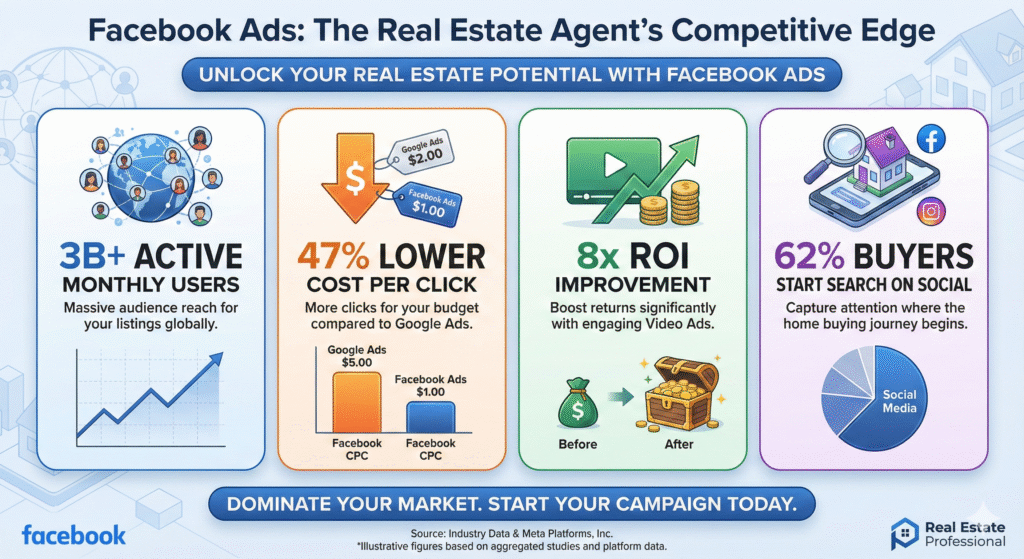
It’s easy to assume that younger demographics have abandoned Facebook entirely, but the data tells a different story. Facebook’s user base of over 3 billion monthly active users includes a substantial portion of homebuyers and sellers across all age groups. What makes Facebook particularly valuable for real estate agents, however, isn’t just the sheer number of users—it’s the platform’s sophisticated targeting capabilities and the fact that people are actively searching for property-related content on it daily.
Unlike other platforms, Facebook allows you to target people based on very specific demographic and behavioral criteria. You can reach first-time homebuyers searching for mortgage information, empty nesters ready to downsize, investors looking for rental properties, and dozens of other highly specific audiences. This precision targeting means your advertising budget goes toward reaching genuinely interested prospects rather than blanketing a broad audience with generic messaging.
Furthermore, Facebook’s lower cost per click compared to Google Ads makes it an efficient choice for building brand awareness and generating leads in your local market. When combined with retargeting capabilities that allow you to stay top-of-mind with people who’ve already engaged with your content, Facebook becomes an integral part of a comprehensive marketing strategy.
Understanding Your Target Audience on Facebook
Before creating a single ad, the most successful real estate agents invest time in identifying exactly who they want to reach. This goes beyond simply saying “people interested in buying homes.” Instead, consider creating detailed buyer personas.
A first-time homebuyer has completely different concerns and questions than a luxury home investor. Someone moving from an apartment to their first house needs educational content about mortgages, home inspections, and the closing process. A wealthy professional downsizing to a condo might be more interested in lifestyle, proximity to restaurants and culture, and investment potential.
On Facebook, you can create separate campaigns for each persona, tailoring both the ad creative and the landing page experience. A first-time buyer ad might emphasize financing options and neighborhood safety, while a luxury home campaign could focus on exceptional architectural details and investment appreciation potential.
Age, location, interests, and behaviors are all customizable in Facebook’s ad manager. You can target people who have recently moved to your area, those actively researching real estate in your zip code, or people interested in home improvement and interior design. The more specific you can be, the better your results will be.
Crafting Ad Creative That Actually Converts
The most expensive Facebook targeting in the world won’t help you if your creative doesn’t resonate with your audience. Real estate agents need to think beyond simple photos of properties.
High-quality video content dramatically outperforms static images on Facebook. Consider creating 15-30 second virtual walkthroughs of your listings, neighborhood spotlights that showcase local amenities, or educational content about the home-buying process. A video showing the transformation of a fixer-upper or highlighting a unique architectural feature will stop people scrolling through their feed far more effectively than a standard property photo.
Testimonials and social proof are incredibly powerful. Video testimonials from satisfied clients talking about their experience working with you build trust and credibility. Before-and-after neighborhood transformations, success stories about buyers who found their dream home, and statistics about your market expertise all contribute to establishing you as a reliable professional.
Don’t overlook the power of educational content either. Real estate agents who provide genuine value through their advertising—explaining the steps of a home sale, breaking down mortgage options, or discussing what to look for in a neighborhood—build authority and trust. This positions you as a knowledgeable guide rather than just another salesperson.
The ad copy itself deserves careful attention. Avoid generic statements like “Find Your Dream Home Today.” Instead, write copy that speaks directly to your audience’s pain points and desires. For sellers: “Concerned about market timing? Let’s discuss how to position your home for maximum value.” For buyers: “We’ve helped 200+ families find homes they love. Discover what’s available in your price range today.”
Structuring Your Campaigns for Maximum Results
Successful Facebook advertising for real estate requires a strategic approach to campaign structure. Rather than running one blanket campaign, organize your efforts around specific goals and audiences.
Create separate campaigns for lead generation, brand awareness, and direct sales. Within each campaign, create ad sets targeting different audience segments with different messaging. You might have one ad set targeting people interested in selling their homes in your area, another targeting young professionals looking to buy their first home, and another retargeting website visitors who didn’t complete a contact form.
Your landing pages are crucial. Don’t direct Facebook ad traffic to your homepage. Instead, create dedicated landing pages specifically designed to convert people coming from your ads. A landing page for a luxury home listing should look different from one targeting first-time homebuyers. These pages should have a single clear call-to-action—whether that’s scheduling a consultation, downloading a buyer’s guide, or requesting a home valuation.
The customer journey matters tremendously. Your awareness-level ads might show neighborhood spotlights or educational content to reach cold audiences. Consideration-level ads can showcase specific properties and client testimonials to people who’ve shown interest. Conversion-level ads can focus on limited-time offers or high-value properties to your warmest audience segments.
Advanced Targeting Strategies That Work
Facebook’s Lookalike Audience feature represents one of the most powerful tools in your advertising arsenal. By uploading your past client list or people who’ve submitted a contact form, Facebook can identify similar users with comparable characteristics and interests. This lets you scale your reach to people who closely resemble your best customers.
Retargeting is equally important. Website visitors who don’t immediately convert shouldn’t be abandoned. Pixel-based retargeting shows your ads to people who’ve visited your website or viewed specific listings, keeping your properties and services top-of-mind. Many agents report that the vast majority of their Facebook-driven leads come from retargeting campaigns rather than cold audience targeting.
Geographic targeting allows you to focus exclusively on your service areas. You can target specific zip codes, neighborhoods, or even draw custom map boundaries around areas where you specialize. This ensures you’re not wasting budget on people outside your market.
Don’t forget about Facebook’s custom audiences based on offline data. If you’ve collected email addresses from open houses, client events, or past transactions, you can upload those email lists to create custom audiences, and then show ads specifically to those people or exclude them to avoid wasting money on individuals already familiar with your services.
Budget Management and ROI Tracking
One of the biggest mistakes agents make is spreading their budget too thin across too many campaigns. It’s better to allocate a meaningful budget—at least $10-15 per day—to a well-structured campaign than to run dozens of campaigns on shoestring budgets that never generate meaningful data.
Set up proper conversion tracking from the beginning. Every important action on your website should be tracked through Facebook’s pixel. This includes form submissions, phone calls, property views, and whatever other goals matter most to your business. Without proper tracking, you’re making optimization decisions in the dark.
Calculate your metrics carefully. Cost per lead, cost per qualified lead, and ultimately cost per closed transaction should all be tracked. If you’re spending $50 per lead and your average transaction nets you $10,000, that’s incredibly profitable. Understanding these numbers allows you to make data-driven decisions about where to allocate your budget.
A/B testing is your friend. Test different ad images, headlines, audience segments, and landing pages. Systematically identify what works and what doesn’t. Over time, small improvements in your click-through rate or conversion rate compound into dramatically better results.
Common Mistakes to Avoid
Many real estate agents underestimate the importance of frequency capping. Showing the same ad to the same person more than a few times per week can generate ad fatigue and resentment. Facebook allows you to control how often your ads appear to the same person, which helps maintain a positive perception of your brand.
Avoid overly promotional messaging. People scroll Facebook to socialize and consume content, not to be sold to constantly. Balance promotional property listings with educational content, market insights, and neighborhood highlights. A typical healthy mix might be 30% promotional content and 70% value-added content.
Poor landing page experiences kill conversions. If your ad promises one thing but your landing page delivers something different, or if the page takes too long to load, people will bounce immediately. Mobile optimization is non-negotiable since the majority of Facebook users are on mobile devices.
Finally, don’t set campaigns and forget about them. Facebook advertising requires active management. Review your performance weekly, pause underperforming ads, increase budgets for winners, and continually test new approaches. The agents winning with Facebook are constantly optimizing and improving their campaigns.
The Future of Real Estate Marketing
As Facebook continues to evolve and competition for attention increases, agents who master this platform early will have significant advantages. The integration of AI-powered bidding strategies, improved conversion tracking through aggregated measurement, and new creative formats like Reels and collections are opening up new opportunities for savvy marketers.
The agents who will dominate real estate marketing in 2025 and beyond won’t be those relying solely on traditional methods. They’ll be the ones who understand their audience deeply, create compelling content that resonates with specific demographics, and continuously optimize their approach based on data and performance.
Your next client is actively searching for properties on Facebook right now. They’re looking at neighborhood information, reading testimonials from past clients, and trying to determine which agent they can trust with one of the biggest decisions of their lives. Facebook advertising gives you the tools to reach them with exactly the right message at exactly the right time.
The question isn’t whether you should be advertising on Facebook—it’s how quickly you can get started and begin capturing the leads that are currently going to your competitors.
🏠 Facebook Ads for Real Estate Agents
Master Facebook Advertising to Generate More Leads & Close More Sales
Why Facebook Ads Matter
Advanced Targeting Options
📍 Geographic Targeting
Target specific zip codes, neighborhoods, and custom map boundaries
👥 Lookalike Audiences
Find users similar to your best clients using your contact lists
🔄 Retargeting
Re-engage website visitors and past contact form submitters
💼 Behavior Based
Target home buyers, sellers, investors, and lifestyle-specific segments
📧 Custom Audiences
Upload email lists and past client data for precise targeting
🎯 Interest Based
Reach people interested in home improvement, interior design, and more
Winning Creative Strategies
Budget Allocation Strategy
Awareness
Educational & neighborhood content to cold audiences
Consideration
Specific properties & testimonials to warm leads
Conversion
High-value offers & retargeting to hot prospects
💰 Track These Metrics
$15-50
$25-75
15-25%
1-3%