What Is Gemini?
Google’s Gemini represents a fundamental shift in how the tech giant approaches artificial intelligence. Launched in December 2023, Gemini was architected as a natively multimodal AI model, meaning it processes text, images, audio, and video within a single integrated framework rather than treating these as separate capabilities bolted onto a text-based system. This architectural choice was deliberate—Google designed Gemini from the ground up to understand and generate across multiple modalities seamlessly.
Gemini comes in three primary tiers: Gemini Nano (for on-device applications), Gemini Pro (the general-purpose version), and Gemini Ultra (the most capable variant). The model builds on Google’s extensive research into transformer architectures and benefits from integration with Google’s vast knowledge infrastructure, including search capabilities, knowledge graphs, and real-world information systems. As Google’s response to ChatGPT’s explosive growth, Gemini incorporates years of accumulated research and positions itself as enterprise-grade AI accessible to both consumers and organizations through Google’s ecosystem.
The model demonstrates particular strength in reasoning tasks, mathematical problem-solving, code generation, and multimodal understanding. Its integration with Google Workspace tools means users can analyze documents, spreadsheets, and presentations directly without leaving their familiar work environment. For organizations already embedded in Google’s ecosystem, Gemini offers seamless integration with Gmail, Docs, Drive, and other services.
What Is ChatGPT?
ChatGPT, launched by OpenAI in November 2022, fundamentally changed how the world perceived AI capabilities. Built on the GPT (Generative Pre-trained Transformer) architecture, ChatGPT demonstrated that large language models could engage in remarkably natural conversations, answer complex questions, assist with writing, explain concepts, and help solve problems across virtually every domain imaginable.
The platform evolved rapidly through iterations: GPT-3.5 provided the initial foundation, GPT-4 introduced significant capability improvements, and GPT-4o brought optimized performance and multimodal capabilities. ChatGPT became the fastest-growing application in internet history, reaching 100 million users within two months of launch. This explosive adoption created an extensive ecosystem of integrations, plugins, and community-developed applications.
ChatGPT’s strength lies in conversational fluency, extensive real-world optimization, and widespread availability. The model excels at maintaining context across long conversations, adapting its tone and complexity to user needs, and generating creative content. Its freemium model democratized access to advanced AI, while premium subscriptions unlock enhanced features including GPT-4 access, faster response times, and plugin capabilities. The platform’s API accessibility has enabled thousands of developers to build applications leveraging ChatGPT’s capabilities.
The Big Differences Between Gemini and ChatGPT
Several fundamental differences distinguish these two AI systems beyond surface-level feature comparisons.
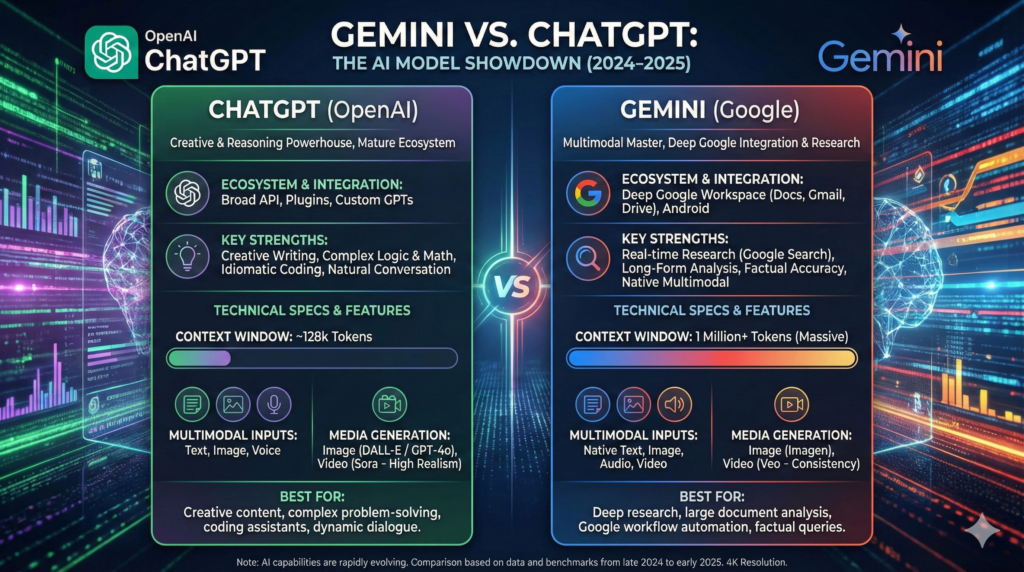
Architectural Philosophy: Gemini was designed multimodal-first, integrating all data types into a cohesive system. ChatGPT evolved as primarily text-focused, with multimodal capabilities (vision) added later to an existing architecture. This distinction affects how each model processes information and the elegance with which it handles cross-modal tasks.
Ecosystem Integration: ChatGPT operates as a standalone platform accessible through web, mobile, and API. Users can access it regardless of their other technology choices. Gemini deeply integrates with Google’s ecosystem—particularly Google Workspace, Gmail, Drive, and Android devices. This creates a friction-free experience for Google users but requires context-switching for those outside Google’s world.
Knowledge and Grounding: ChatGPT has been extensively trained on internet data up to its knowledge cutoff, with web search capabilities available in certain versions. Gemini benefits from real-time access to Google Search and potentially more sophisticated grounding through Google’s knowledge infrastructure. This affects how current and verified the information each model provides can be.
Deployment and Accessibility: ChatGPT achieved faster mainstream adoption through its aggressive freemium strategy and standalone nature. Gemini’s integration into Google products means many users encounter it naturally without explicit subscription decisions, though awareness levels have been lower outside the Google-immersed user base.
Model Sizes and Specialization: Google offers multiple Gemini variants optimized for different devices and use cases (Nano, Pro, Ultra), while OpenAI has focused on fewer, more general-purpose models. This reflects different philosophies about specialization versus generalization.
Gemini vs. ChatGPT: Feature-by-Feature Comparison
Conversation and Dialogue: Both excel at natural conversation, but ChatGPT has benefited from longer optimization for this specific domain. ChatGPT feels marginally more human-like in extended conversations, with slightly better context retention and conversational flow. Gemini performs exceptionally well but has slightly less real-world battle-testing. Both maintain context effectively across long dialogues, though neither has unlimited memory—previous conversations must be explicitly referenced.
Multimodal Analysis: Gemini’s native multimodal architecture allows genuinely integrated analysis across text, images, audio, and video. Users can upload complex documents, charts, and visual materials, and Gemini analyzes them within the same context as text prompts. ChatGPT’s vision capabilities, while capable, feel more like a separate system. For visual document analysis, screenshot interpretation, or image-based problem-solving, Gemini offers a more cohesive experience.
Code Generation and Debugging: Both perform exceptionally for coding tasks. ChatGPT demonstrates particular strength in explaining code and providing step-by-step solutions. Gemini matches this capability while adding advantages in multimodal code scenarios—such as converting screenshots of UI designs into functional code or referencing visual API documentation. For pure code generation, the differences are minimal.
Mathematical and Logical Reasoning: Benchmark testing suggests Gemini demonstrates superior performance on complex reasoning tasks, mathematical problem-solving, and logical analysis. Gemini consistently outperforms GPT-4 on certain academic reasoning benchmarks. ChatGPT remains highly capable but shows marginally weaker performance on pure mathematical reasoning tasks that don’t require extensive explanation.
Creative Writing: ChatGPT’s strength lies in creative writing—generating stories, poetry, scripts, and imaginative content with natural flow. The model’s conversational nature translates exceptionally well to creative domains. Gemini produces quality creative content but is often perceived as slightly more functional and less creative in tone, though differences are subtle and subjective.
Real-Time Information: ChatGPT’s web search feature provides access to current information. Gemini has similar search integration through Google. Both effectively provide updated information about recent events, current prices, and breaking news. Google’s advantage here is potentially deeper—Gemini might provide more contextually rich results given Google’s search dominance—but practical differences in user experience are minor.
Integration with Productivity Tools: This represents ChatGPT’s learning curve for non-Google users. Gemini integrates directly with Gmail, Docs, Sheets, Slides, and Drive—users can activate Gemini assistance without leaving these tools. ChatGPT requires workarounds like third-party integrations or manual copying. For Google Workspace users, Gemini’s integration is transformative; for others, ChatGPT’s standalone nature is advantageous.
Comparing Benchmarks: Gemini 3 Pro vs. ChatGPT 5.1
Benchmark comparisons provide quantitative insight, though they represent narrow slices of overall capability and don’t capture subjective quality factors.
Academic Reasoning: Gemini 3 Pro demonstrates strong performance on reasoning benchmarks (MMLU, GSM8K). ChatGPT 4 shows competitive but slightly lower scores on pure reasoning tasks. However, the difference is often narrow, with performance variations depending on specific benchmark categories.
Coding Performance: Both models achieve high scores on coding benchmarks (HumanEval, MBPP). ChatGPT 4 maintains a slight edge on multi-file programming tasks and code explanation, while Gemini performs competitively. The practical differences are negligible for most developers.
Multimodal Understanding: Gemini demonstrates clear advantages on multimodal benchmarks (MMBench, ChartQA) due to its native architecture. ChatGPT’s vision capabilities, while capable, show performance gaps on visually complex reasoning tasks.
Knowledge and Factuality: Benchmark results depend heavily on knowledge cutoff dates and test design. Both models show similar hallucination rates on factual recall tasks. Real-world testing suggests ChatGPT may have slightly better performance on some current events (due to longer availability of web search), while Gemini’s grounding through Google Search might provide advantages in others.
Speed and Efficiency: Gemini Nano is specifically optimized for on-device performance, showing significant advantages in latency and resource consumption on mobile devices. ChatGPT prioritizes a consistent experience across devices rather than extreme optimization for mobile. For cloud-based usage, both show competitive response times, with variations depending on load and server location.
Multilingual Performance: Both perform well across languages, though specific performance varies by language. Gemini shows particular strength in non-English languages due to Google’s global user base, while ChatGPT performs comparably across major languages.
Pros and Cons of Gemini and ChatGPT
Gemini Pros
- Native multimodal integration (text, image, audio, video in one system)
- Superior performance on mathematical and logical reasoning benchmarks
- Seamless integration with Google Workspace (Docs, Sheets, Slides, Gmail, Drive)
- Real-time access to Google Search information
- Gemini Nano for on-device processing on mobile
- Deep knowledge grounding through Google’s infrastructure
- Efficient performance across different device types
Gemini Cons
- Lower mainstream awareness compared to ChatGPT
- Harder to access for non-Google ecosystem users
- Smaller community of developers and use-case examples
- Less real-world optimization in some conversational domains
- Integration advantages disappear for non-Google users
- Fewer third-party plugins and integrations available
ChatGPT Pros
- Exceptional conversational ability and natural dialogue
- Massive ecosystem of integrations, plugins, and community solutions
- Extensive real-world testing and optimization
- Accessible as standalone platform independent of other services
- Largest user base and community support
- Superior performance on creative writing tasks
- Well-documented API for developers
- Fastest overall adoption and marketplace development
- Strong performance on code explanation and debugging
ChatGPT Cons
- Text-focused architecture, with vision added secondarily
- Less native elegance for multimodal tasks
- Requires subscription for access to most capable models
- Standalone nature means less integration with productivity tools
- Slightly weaker performance on pure mathematical reasoning
- Knowledge cutoff limitations without active web search
- Higher API costs for heavy usage
- Less optimization for mobile/on-device processing
Which AI Model Should You Use?
The optimal choice depends entirely on your specific situation, requirements, and existing ecosystem.
| Factor | Choose Gemini | Choose ChatGPT | Consideration |
|---|---|---|---|
| Primary Use Case | Multimodal analysis, visual documents | General conversation, writing | What will you use it for most? |
| Existing Ecosystem | Heavy Google Workspace user | Independent platform user | Which tools do you already use daily? |
| Mathematical/Reasoning Tasks | Complex logic, academic problems | General problem-solving | Do you need specialized reasoning performance? |
| Creative Writing | General content | Stories, poetry, scripts | How important is creative flair? |
| Coding Assistance | Multimodal code scenarios | Pure code generation | Do you need visual documentation analysis? |
| Real-Time Information | Comparable (Google Search) | Comparable (Web Search) | How current must your information be? |
| Productivity Integration | Gmail, Docs, Drive, Sheets | Third-party integrations | Which tools must AI integrate with? |
| Mobile/On-Device | Superior (Nano optimized) | Standard | Do you need on-device processing? |
| Standalone Access | Limited outside Google | Excellent | How important is platform independence? |
| Community Resources | Smaller community | Massive community | How much do community examples matter? |
| Cost Consideration | Google Cloud pricing | Pay-per-token, subscription | What’s your budget structure? |
| Learning Curve | Easier for Google users | Standalone learning needed | How embedded are you in your current ecosystem? |
Decision Framework
Choose Gemini if you:
- Use Google Workspace extensively (Gmail, Docs, Drive, Sheets)
- Need multimodal capabilities (analyzing images, documents, charts)
- Require superior mathematical and logical reasoning
- Work on Android devices or need on-device AI processing
- Benefit from direct Google Search integration
- Want a more integrated, unified experience within existing Google tools
Choose ChatGPT if you:
- Need the most natural, fluid conversational experience
- Work outside Google’s ecosystem
- Require extensive third-party integrations and plugin support
- Value the largest community of users and documented use cases
- Do primarily text-based work (writing, explanation, ideation)
- Want standalone platform independence
- Need the most mature, battle-tested AI assistant
Consider Using Both if you:
- Have different team members with different ecosystem preferences
- Need specialized capabilities from each (ChatGPT for conversation, Gemini for multimodal)
- Want to avoid being locked into a single platform
- Have the budget and technical capacity to maintain integrations with both
The Nuanced Reality
The honest truth is that both Gemini and ChatGPT represent frontier-level artificial intelligence. The performance differences on most real-world tasks are marginal—perhaps 5-10% at most on specific benchmarks, and often imperceptible in practical usage. The real decision factors are ecosystem fit, integration requirements, and specialized needs rather than raw capability differences.
Rather than declaring a universal winner, recognize that you’re choosing between two excellent options optimized for different contexts. ChatGPT maintains advantages in conversational fluency and ecosystem maturity, while Gemini provides architectural advantages for multimodal work and integration with Google’s tools.
The AI landscape will likely continue supporting multiple competitive systems, each serving different user bases effectively. Your best choice is the one that fits seamlessly into your existing workflow, integrates with your current tools, and addresses your specific use cases. As both platforms continue evolving, periodic reassessment of which serves your needs best remains wise—the AI landscape moves quickly, and today’s advantages may shift tomorrow.