
The travel industry stands at an inflection point. For decades, the process of planning and executing a trip has remained fundamentally unchanged: you research destinations, compare prices, make bookings, coordinate logistics, and hope nothing goes wrong. It’s a process that consumes countless hours and often leaves travelers frustrated, stressed, and unable to focus on what they actually came for—experiencing the world.
Enter agentic AI: artificial intelligence systems designed not just to provide information, but to take autonomous action toward achieving your goals. Unlike conventional travel apps that require you to make every decision and click every button, agentic AI agents actively plan, book, coordinate, and adapt on your behalf. They operate with genuine autonomy, making decisions within your preferences and parameters, and continuously learning from your travel patterns.
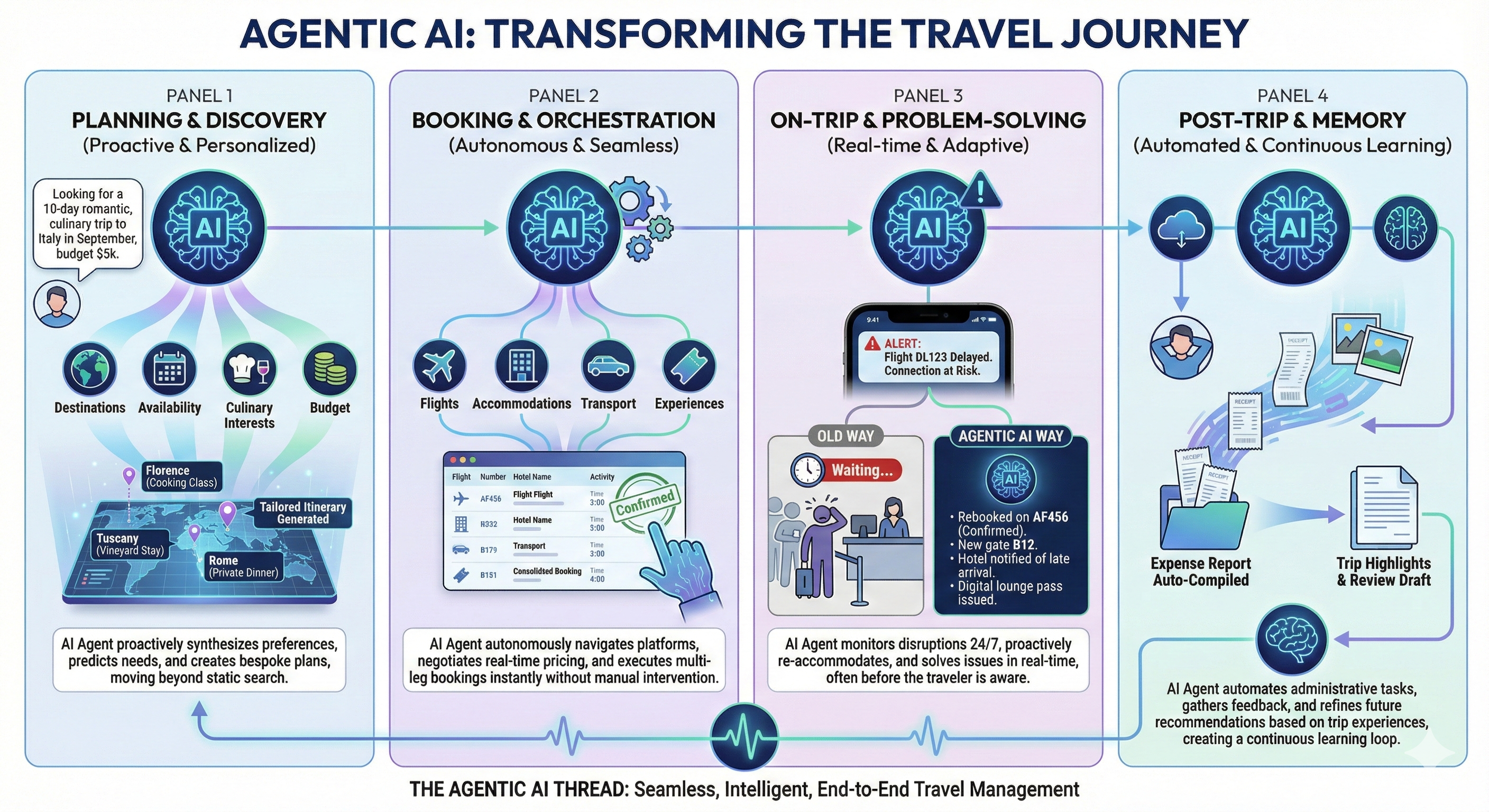
The transformation will unfold across four distinct but interconnected stages: Planning & Discovery, Booking & Orchestration, On-Trip & Problem-Solving, and Post-Trip & Memory. Together, these stages create a complete travel ecosystem where AI handles logistics while you focus on living.
Panel 1: Planning & Discovery – Proactive & Personalized
The journey begins long before you book anything. It begins with understanding what you actually want from travel, and this is where traditional travel planning falls short. Most tools offer generic recommendations based on popularity or your search history. Agentic AI takes a fundamentally different approach.
Imagine telling your AI agent once: “I love immersive experiences over landmarks, I prefer slower travel with deeper connections to places, I’m vegan, I travel on a moderate budget, and I’m interested in sustainable tourism.” Rather than searching for this information each time you plan a trip, your agent remembers these core preferences. More importantly, it actively thinks about your next adventure.
An agentic AI system becomes a proactive travel companion. Instead of waiting for you to search, it continuously monitors the travel landscape—tracking when prices drop to your preferred destinations, noticing when festivals align with your interests, identifying emerging destinations that match your travel philosophy, and even predicting the optimal time for you to visit based on weather, crowds, and seasonality.
The personalization goes deeper than preferences. Advanced agentic systems can understand your travel rhythm. If your historical data shows you prefer trips every six months, in autumn and spring, lasting two to three weeks, your agent will proactively surface options during those windows. If past trips reveal you gravitate toward Southeast Asia but have never explored South America, the system might begin recommending South American destinations with a clear explanation of why they align with your established preferences.
Discovery becomes genuinely intelligent. Rather than relying on what’s trending on travel blogs or what travel agencies push, agentic AI can identify hidden gems by synthesizing multiple data sources: local knowledge bases, off-the-beaten-path accommodations, authentic experiences not yet commodified by tourism, cultural events, seasonal specialties, and accessibility information. It constructs not just a list of destinations, but coherent narratives—complete travel stories where each element reinforces a theme.
For a traveler interested in sustainable food systems, the agent might construct an itinerary visiting organic farms in Tuscany, connecting to a biodynamic vineyard tour, including a market-to-table cooking class, and researching restaurants run by chefs sourcing from local producers. Each element serves the narrative. Each recommendation feels personal because it is.
Weather, crowd predictions, and event timing become built into planning automatically. The agent knows the optimal window for visiting a destination—not just when it’s pleasant, but when it aligns with festivals you’d enjoy, when crowds are manageable, when prices are reasonable, and when local experiences are available. This level of coordination is impossible for humans to manage across multiple destinations.
Panel 2: Booking & Orchestration – Autonomous & Seamless
Once planning is complete, execution begins, and this is where agentic AI delivers extraordinary value. Today’s booking process is fragmented: you book flights on one platform, hotels on another, activities on a third, ground transportation on a fourth. Each booking exists in isolation, and coordination is your responsibility.
An agentic AI system treats booking as a unified optimization problem. Given your itinerary and preferences, the agent autonomously books across all necessary platforms simultaneously. But it doesn’t just book—it optimizes. It considers not just price, but combinations: a slightly more expensive flight that arrives at a better time for your accommodation check-in, bundled with transit options that create a seamless arrival experience, is preferable to the cheapest flight that creates logistical complications.
Dynamic pricing becomes a solved problem. Rather than you obsessively checking for price drops, the agentic system continuously monitors prices across all your bookings. If better prices emerge, it can automatically rebook, capturing savings and rebooking any dependent services accordingly. If a price drop entitles you to compensation through various travel loyalty programs, the agent handles the claims.
Multi-modal coordination becomes seamless. The agent understands that your international flight lands at 11 AM, you need two hours for airport procedures and immigration, you have a 90-minute drive to your accommodation, and check-in isn’t until 3 PM. It times ground transportation accordingly, potentially suggesting a luggage storage service and a nearby lunch spot to fill the gap productively. If a flight delays, the agent instantly recalculates, automatically rebooking your ground transfer, notifying your hotel of the new arrival time, and adjusting subsequent days as needed.
Expense optimization becomes continuous. Rather than you tracking receipts and managing budgets, the agentic system maintains a real-time expense ledger, optimizes for the best currency exchange rates, identifies cashback or reward opportunities, and alerts you when spending approaches thresholds. For business travelers, it automatically generates expense reports.
Negotiation on your behalf becomes possible at scale. If you’re booking a hotel with a slight damage risk or weather concerns, the agent can negotiate modified cancellation policies. If standard rates apply to your dates but rates for adjacent dates are significantly lower, the agent might propose rebooking plus compensation. Rather than you having these conversations, your agent handles them, armed with clear authority and parameters you’ve set.
Panel 3: On-Trip & Problem-Solving – Real-Time & Adaptive
The real magic of agentic AI emerges when plans encounter reality. Delays happen. Cancellations occur. Weather changes. Accommodations have problems. In traditional travel, these situations derail your day and require hours of stressful problem-solving.
An agentic system monitoring your trip in real-time transforms this. Your flight gets delayed? Within moments, the agent has identified the delay’s duration, assessed impact on downstream connections, proactively booked alternative flights if necessary, rearranged ground transportation, and notified your accommodation of the new arrival time. You might not even realize there was a problem until you’re smoothly rerouted.
The same applies to accommodations. Bad room conditions? The agent documents the issue, negotiates with management, and books alternatives if necessary, moving your luggage and updating your reservations. Restaurant you planned to visit permanently closed? The agent identifies alternatives matching your preferences and rebooking if there were reservations.
Real-time contextual recommendations become invaluable. Your agent knows exactly where you are, what you’ve already experienced, what you’ve expressed interest in, current weather conditions, real-time crowd levels at attractions, your energy level based on activity history, and local events happening today. It can surface opportunities with remarkable precision: “There’s a jazz concert at a venue 15 minutes walk from you starting in three hours. Based on your listening history and this trip’s pacing, I think you’d love it. Should I get tickets?”
Accessibility and personalized routing transform how people navigate destinations. For travelers with mobility challenges, dietary restrictions, or health needs, the agent maps accessible routes, identifies nearby facilities, locates restaurants matching dietary requirements with verified information, and coordinates any necessary services. This doesn’t just make travel easier; it makes certain types of travel possible.
Local knowledge becomes actionable. The agent accesses real-time local information—traffic conditions, public transportation status, hidden parking, local customs, safety information, emergency services locations. It understands that the beautiful neighborhood you’re walking through becomes less safe after dark, and proactively suggests alternative routes or transportation.
24/7 concierge support becomes genuinely accessible. Rather than calling a hotel concierge and hoping they understand your needs, your agentic system understands your complete context. It knows what you’ve enjoyed previously, your preferences, your schedule, your budget parameters, and can provide recommendations or handle arrangements with full contextual understanding.
Panel 4: Post-Trip & Memory – Automated & Continuous Learning
The journey doesn’t end when you return home. This is where agentic AI’s most powerful capability emerges: continuous learning and improvement across the complete travel lifecycle.
Expense reconciliation becomes automatic. Rather than spending hours organizing receipts and categorizing expenses, the agent has maintained a complete transaction record throughout your trip, automatically categorized spending, reconciled accounts, and generated comprehensive reports. For business travelers, expense reports are ready for submission. For leisure travelers, expense analysis reveals actual spending versus budget and cost per experience.
But more importantly, the system begins learning. It analyzes not just what you booked, but how you felt about it. Which restaurants did you return to? Which neighborhoods did you linger in? Which activities felt rushed versus paced perfectly? Which recommendations proved surprisingly valuable? Which aspects of the itinerary didn’t resonate?
This analysis becomes progressively more sophisticated. By your third or fourth trip, the agent has identified patterns: you consistently prefer quieter mornings and active afternoons; you enjoy cultural experiences most when led by locals; you favor walkable neighborhoods; you return to restaurants multiple times when food quality is exceptional but also when atmosphere feels authentic. The agent has essentially learned your travel personality.
Travel preference learning extends beyond individual preferences to pattern recognition. The agent notices you consistently book trips to warm destinations in winter and cool destinations in summer. It sees you gravitate toward coastal regions but have never explored mountains. It recognizes that your solo travel style differs from your family travel style. These insights become the foundation for better future recommendations.
Memory curation becomes automatic. Rather than you sifting through thousands of photos to create a travel summary, the agent curates a narrative. It identifies the moments that mattered most—the meals where you lingered longest, the conversations that created genuine connection, the sunrise views that stopped you in your tracks. It weaves these into a coherent travel story with photo sequences, notes you made, and even ambient data like music you listened to or books you read.
The system enables sharing and integration. It can automatically create social media posts if you want, generate a travel blog with minimal your effort, or create printed photo books. More meaningfully, it can share travel data with friends and family—allowing loved ones to experience your journey through curated updates and photos.
Continuous learning becomes cyclical. With each trip, your agent develops richer understanding of what brings you joy, what travel means to you, and how to create experiences you’ll treasure. This learning compounds across years. A traveler who’s taken twenty trips with an agentic system has essentially given that system a complete education in their travel personality and preferences.
The system can also help you intentionally expand your horizons. If it learns you always book beach destinations, it can periodically surface mountain trips with clear reasoning for why they might resonate. It becomes not just a reflection of your preferences, but a thoughtful guide helping you discover aspects of travel you didn’t know interested you.
The Transformation
These four panels represent more than a better way to travel. They represent a fundamental shift in how humans relate to travel logistics. Rather than travel planning being an obstacle to experiencing the world, it becomes transparent. The anxiety of coordination, the tedium of research, the stress of problem-solving—these migrate to systems designed to handle them.
The real transformation is liberation. When logistics are handled autonomously and reliably, your energy and creativity focus on what travel is really about: connection, discovery, and transformation. You stop asking “Can I plan this trip?” and start asking “What kind of experience would I like to have?”—knowing that your agentic AI companion will handle the intricate work of bringing that experience to life.
The future of travel isn’t about traveling more or faster. It’s about traveling more intentionally, more authentically, and more joyfully. And agentic AI is the technology that makes that future possible.