
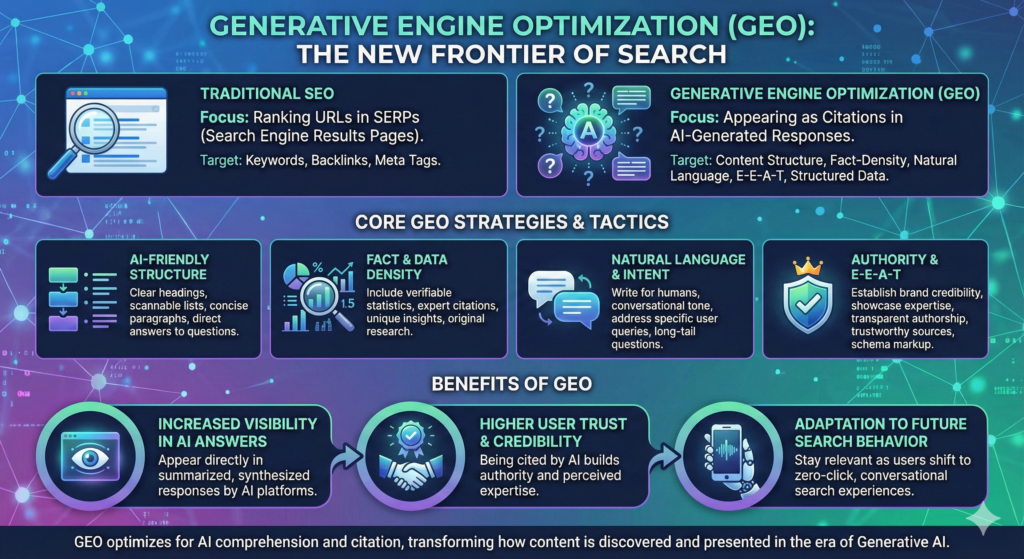
The digital landscape is shifting beneath our feet. For nearly two decades, SEO has dominated the conversation around search visibility and organic traffic. But a new player has emerged: Generative Engine Optimization (GEO). As AI-powered answer engines like Google’s AI Overviews, ChatGPT, Perplexity, and Gemini reshape how people search, marketers must adapt their strategies to thrive in this new era. This comprehensive guide explores what GEO is, how it differs from traditional SEO, and the strategies you need to master to optimize for generative AI.
What Is Generative Engine Optimization (GEO)?
Generative Engine Optimization refers to the practice of optimizing web content to be discovered, cited, and ranked by AI-powered search engines and answer engines. Unlike traditional SEO, which focuses on keyword rankings in blue-link results, GEO targets the generative AI systems that synthesize information from multiple sources to provide direct answers to user queries.
At its core, GEO recognizes a fundamental truth: when users ask questions to ChatGPT, Google’s AI Overview, or Perplexity, they’re not looking for a list of links. They want answers. And those answers are generated from source material that AI systems crawl, analyze, and cite. Your goal as a marketer is to ensure your content is the source that gets cited—not just ranked.
The term “Generative Engine Optimization” encompasses several related concepts in the industry, including AI search optimization, Large Language Model (LLM) optimization, and Search Generative Experience (SGE) optimization. But the principle remains constant: optimize for how AI discovers, evaluates, and presents information.
Think of it this way: SEO is about getting on the first page of Google. GEO is about getting into an AI’s answer. The real estate has changed, and the rules of visibility have evolved.
GEO vs. SEO: Understanding the Relationship
How Is GEO Similar to SEO?
At their foundation, GEO and SEO share critical similarities. Both require high-quality, relevant content. Both demand technical excellence and proper structure. Both rely on authority and trust signals. Both benefit from E-E-A-T—Expertise, Experience, Authoritativeness, and Trustworthiness—as fundamental ranking factors.
Content quality remains non-negotiable in both contexts. A well-researched article with original insights performs better in traditional search and will more likely be cited by AI systems. Links and domain authority that matter for SEO also matter for GEO, as AI systems consider these signals when determining source credibility.
Additionally, both approaches require understanding user intent. Whether someone is clicking a link or asking an AI, they’re searching for answers. Meeting that intent through comprehensive, clear content is essential in both worlds.
How Is GEO Different from SEO?
While similarities exist, the differences are profound and require strategic shifts:
Citation Over Ranking: In SEO, you fight for ranking positions. In GEO, you fight to be cited as a source. Google’s AI Overview might feature 5-10 sources in a single response. Being included as one of those sources is the goal, even if you’re not the top ranking site.
Fact Density Matters More: AI systems are trained on patterns in data. Content packed with unique statistics, original research, data points, and specific facts is more likely to be selected as source material. Generic overview content has diminished value in the GEO era.
Different Query Types: Traditional SEO targets keyword volume and search intent. GEO optimizes for the types of queries AI systems handle well—primarily question-based queries that require synthesis, comparison, or explanation. Transactional queries (“buy running shoes”) still favor traditional search and e-commerce platforms.
Zero-Click Search Reality: While SEO has dealt with zero-click searches for years, GEO amplifies this trend. An AI answer can fully address a user’s question without them ever clicking your site. This requires a mindset shift: visibility without traffic, at least initially, is still valuable for brand authority and positioning.
Structured Data Becomes Critical: AI systems can parse and understand structured data more effectively than traditional search engines. Schema markup, clear hierarchies, and machine-readable formats are no longer nice-to-have features—they’re essential for GEO success.
Answer Format Over Keyword Optimization: In SEO, matching keyword intent is crucial. In GEO, the format of your answer matters equally. AI systems favor clear definitions, numbered lists, comparisons, data visualizations, and authoritative statements that can be easily extracted and synthesized.
GEO vs. SEO Comparison Table
| Aspect | Traditional SEO | Generative Engine Optimization (GEO) |
|---|---|---|
| Primary Goal | Achieve top rankings in search results | Get cited as an authoritative source in AI answers |
| Success Metric | Ranking position (position 1-10) | Citation frequency and source attribution |
| Query Focus | Keyword-based, volume-driven queries | Question-based, intent-driven queries |
| Content Optimization | Keyword matching, meta tags, headers | Fact density, data, original research, clarity |
| Click Behavior | Drives click-through traffic | May not generate immediate clicks (zero-click) |
| Structure | SEO-friendly format with keywords | Machine-readable format with structured data |
| Ranking Factors | Links, domain authority, keywords | Author expertise, E-E-A-T, fact verification |
| Update Frequency | Less critical for ranking | Higher importance for real-time relevance |
| Answer Format | Blue links and snippets | Synthesized answers from multiple sources |
| Competition | Compete with similar pages | Compete to be cited alongside competitors |
| Long-form Content | Beneficial for comprehensive coverage | Essential for multiple citation opportunities |
| Data & Statistics | Nice-to-have supporting elements | Critical differentiators for AI selection |
| Author Authority | Secondary factor | Primary evaluation criteria for AI systems |
| Schema Markup | Helpful enhancement | Essential for AI interpretation |
| User Intent Match | Important for ranking | Critical for being selected as answer source |
| Brand Visibility | Linked to traffic | Built through citations and authority |
Integrating GEO with SEO
The most successful digital strategy doesn’t abandon SEO for GEO—it integrates both. Your content should simultaneously optimize for traditional search rankings and AI citations. This means:
Write comprehensive content that thoroughly answers questions, earning both rankings and citations. Include original research and data that traditional search indexes and AI systems find valuable. Use structured data to improve visibility in both contexts. Build authority signals that matter across all search modalities. Focus on topics where you have genuine expertise, creating the kind of authoritative content that both algorithms and AI systems prefer.
Why GEO Is Important
The importance of GEO cannot be overstated. Here’s why it matters now:
AI is becoming the primary search interface for millions. Surveys show that younger users increasingly turn to ChatGPT and other AI tools instead of Google. By 2025, a significant portion of information-seeking behavior will flow through generative AI systems.
Google’s AI Overviews are reshaping search results. Google has integrated generative AI directly into search, fundamentally changing what the number one position looks like. Sites appearing in AI Overviews gain visibility and credibility.
Citation is the new ranking. Being cited by an AI answering millions of queries provides brand authority that goes beyond traditional traffic metrics.
Your competitors are already adapting. Forward-thinking marketers are repositioning their content strategies, rewriting pages to maximize fact density, and restructuring content to be more easily extracted by AI systems.
Long-term visibility requires GEO readiness. The future of search is hybrid. Brands that optimize only for traditional SEO will miss the largest emerging opportunity in search visibility.
How Generative AI and Answer Engines Work
To optimize for these systems, you need to understand how they function.
Generative AI answer engines work in several steps:
Query Processing: The system receives a user question and analyzes what information would best answer it. If you’re asking “What are the best practices for remote team management?” the AI understands you need actionable advice backed by credible sources.
Source Retrieval: The AI searches its training data and live-index for relevant sources. This isn’t a traditional keyword match—it’s semantic understanding. The system finds content that addresses the conceptual question, not just content with matching keywords.
Source Evaluation: The system ranks sources by credibility, relevance, and authority. E-E-A-T signals matter heavily here. Is this author an expert? Is the domain established? Are there citations supporting the information? Does the content appear authoritative and trustworthy?
Synthesis and Generation: The AI synthesizes information from multiple sources, generates a comprehensive answer, and attributes sources. The quality of your content determines whether it’s selected for synthesis.
Citation and Attribution: Finally, the AI displays your source, often with a direct link or attribution. This is the GEO win—your content is cited as authoritative enough to be included in an AI’s answer.
Understanding this pipeline is critical. Your content needs to be discoverable, evaluable by AI systems, and positioned as an authoritative source on your topic.
AI Answer Engine Workflow Table
| Stage | Description | What AI Systems Evaluate | How to Optimize |
|---|---|---|---|
| 1. Query Processing | User submits question to AI system | Question intent, complexity, entity recognition | Match natural language queries; use clear terminology |
| 2. Source Retrieval | AI searches indexed content and training data | Semantic relevance, content freshness, availability | Use semantic keywords; keep content updated |
| 3. Source Evaluation | AI ranks sources by credibility and authority | E-E-A-T signals, author credentials, domain authority | Build author profiles; establish domain expertise |
| 4. Content Analysis | AI extracts facts, data, and key information | Fact density, original research, data verification | Include statistics, research, original insights |
| 5. Synthesis | AI combines information from multiple sources | Content quality, clarity, accuracy | Write clearly; structure for easy extraction |
| 6. Answer Generation | AI creates comprehensive response | Citation quality, source diversity, answer completeness | Ensure comprehensive coverage of topic |
| 7. Citation & Attribution | AI credits sources and provides links | Source importance, relevance, prominence | Optimize for citation frequency, not just links |
How GEO Works: Practical Mechanics
GEO success requires optimization across several dimensions:
Content Architecture: Structure your content for AI extraction. Use clear headings, concise definitions, numbered lists, and logical flow. AI systems can easily identify and extract well-formatted content. Dense paragraphs are less likely to be selected for citation.
Fact Density: Pack your content with original data, research, statistics, and specific insights. Generic information that AI could generate independently has lower citation value. Unique facts make your content indispensable.
Entity Optimization: Clearly identify the main entities your content addresses. If writing about “remote team management,” define it early, discuss key entities (asynchronous communication, time zones, etc.) explicitly. AI systems understand entity relationships and value content that clarifies them.
Author Expertise Signals: Make author credentials visible. AI systems evaluate author authority. Include author bios, professional credentials, and relevant experience. This directly impacts citation likelihood.
Technical Excellence: Ensure your site loads quickly, is mobile-friendly, and implements proper schema markup. These technical signals matter as much in GEO as SEO.
Primary Sources: When possible, cite research, studies, and primary sources directly. Content that traces back to primary sources is viewed as more authoritative and more likely to be cited.
Comprehensive Coverage: Cover topics thoroughly and comprehensively. AI systems favor content that comprehensively addresses a topic from multiple angles. Short, surface-level articles are less likely to be cited than in-depth, authoritative pieces.
GEO Optimization Strategies Table
| Strategy | Importance | Implementation | Expected Impact |
|---|---|---|---|
| Fact Density | Critical | Include 5-10+ unique data points per 1000 words; cite original research | Higher citation frequency; AI prioritization |
| Structured Data/Schema | Critical | Implement comprehensive JSON-LD markup (Article, Author, Organization) | Better AI comprehension; increased citations |
| Author Authority | High | Create detailed author bios; link author credentials; build author social proof | Improved source credibility evaluation |
| Content Architecture | High | Use clear H2/H3 headers; short paragraphs; numbered lists; bullet points | Easier extraction; higher selection probability |
| Original Research | Critical | Conduct surveys, studies, or proprietary analysis; cite internally | Unique positioning; citation advantage |
| E-E-A-T Signals | High | Demonstrate expertise through credentials; build experience narratives; show trustworthiness | Better ranking in AI evaluations |
| Topic Comprehensiveness | High | Cover 8-15+ subtopics per main topic; create topic clusters | Multiple citation opportunities per query |
| Citation Quality | Medium | Link to primary sources; cite authoritative references | Improved trust assessment by AI |
| Content Freshness | Medium | Update content quarterly; add new data; refresh statistics | Better real-time relevance scoring |
| Technical SEO | High | Fast loading; mobile optimization; clear site structure | Better crawlability for AI systems |
| Answer-Format Optimization | Critical | Use definitions, comparisons, step-by-step guides, data visualizations | Better alignment with AI extraction needs |
| Keyword Semantic Variation | Medium | Use synonyms; cover related concepts; entity-based optimization | Better semantic understanding by AI |
Future Potential of GEO
The future of GEO is expansive and reshaping digital marketing fundamentally.
Vertical Integration: More platforms will integrate AI answers—not just Google, but Amazon, Reddit, industry-specific platforms, and vertical search engines. Each will have different ranking factors, requiring multi-platform GEO strategies.
Real-Time Search: Generative search will increasingly provide real-time answers. Content freshness and real-time relevance will matter more than ever. Brands will need to continuously update content to stay cited.
Conversational Search: Multi-turn conversations with AI will replace simple query-answer patterns. Brands will optimize for conversation continuity and depth, not just single queries.
Specialized Models: Domain-specific generative AI models are emerging. Legal research, medical advice, financial planning—each will have specialized AI systems. Optimization will become increasingly vertical and specialized.
Synthetic Content vs. Real Content: As AI-generated content floods the internet, real, authoritative, original content will become rarer and more valuable. This creates an opportunity for brands with genuine expertise and unique insights.
Direct AI Partnerships: Leading brands may develop direct relationships with major AI platforms, optimizing content specifically for ChatGPT, Gemini, or Perplexity integrations. This is already happening in select industries.
AI Platforms & GEO Optimization Table
| Platform | Focus Area | Primary Users | Optimization Priority | Key Ranking Factors |
|---|---|---|---|---|
| Google AI Overviews | Integrated search results | Desktop & mobile searchers | Very High | Domain authority, EEAT, content freshness |
| ChatGPT Search | Conversational Q&A | Information seekers | High | Citation quality, comprehensiveness, authority |
| Perplexity AI | Research & synthesis | Researchers, students | High | Fact density, original data, source quality |
| Google Gemini | Multimodal responses | General knowledge queries | High | Content variety, multimedia integration |
| Bing Chat | Integration with search | Bing/Microsoft users | Medium | Technical signals, content structure |
| Claude (Anthropic) | Long-form responses | Deep research users | Medium | Comprehensiveness, nuance, accuracy |
| Specialty AI Tools | Industry-specific | Domain professionals | High (by vertical) | Domain expertise, precise data, terminology |
Strategies for GEO Success
To optimize for generative AI effectively, implement these core strategies:
Become a Fact Repository: Collect, verify, and present original research, data, and insights. Be the source that AI systems want to cite. Original research is your most valuable asset in the GEO era.
Optimize for Multiple Query Formats: Some questions expect definitions (factual), others expect lists (instructional), others expect comparisons (analytical). Structure your content to serve these different query types.
Build Author Authority: Invest in author brands and expertise signals. Create author pages, encourage bylines, build social proof, and make expertise visible. Author authority is increasingly important in AI evaluation.
Master Structured Data: Implement comprehensive schema markup covering your content type, author, organization, and key facts. Make your content machine-readable for maximum AI accessibility.
Establish Domain Authority: High-domain-authority sites are more likely to be cited. Earn links, build brand presence, secure media coverage, and establish yourself as an authority in your space.
Create Content for Citation, Not Just Traffic: Accept that some content will be cited by AI systems without generating direct clicks. This citation still builds brand authority and positions you as an expert.
Stay Updated on AI Developments: Follow changes in how Google AI Overviews, ChatGPT, and other systems work. GEO is evolving rapidly, and strategies that work today may shift tomorrow.
GEO Content Checklist Table
| Element | SEO Essential | GEO Essential | Implementation Guide |
|---|---|---|---|
| Keyword Optimization | Yes | Partial | Use keywords naturally; prioritize semantic relevance |
| Meta Descriptions | Yes | No | Keep for click-through; not critical for AI |
| Title Tags | Yes | Partial | Make descriptive; include primary topic/entity |
| H1-H3 Headers | Yes | Yes | Use for structure; help AI parse content hierarchy |
| Internal Links | Yes | Partial | Link contextually; not primary for AI ranking |
| External Links | Yes | Yes | Cite primary sources; strengthen credibility |
| Author Bio | No | Yes | Include credentials, expertise, social links |
| Publication Date | Helpful | Yes | Display clearly; update regularly |
| Fact Verification | No | Yes | Cite sources for claims; show research backing |
| Schema Markup | Helpful | Yes | Implement Article, Author, Organization schema |
| Data Visualization | No | Yes | Use charts, infographics to present data |
| Original Research | No | Yes | Conduct studies; present unique data |
| Content Length | Yes (1500+) | Yes (2000+) | Comprehensive coverage; 2000-4000 words ideal |
| Readability | Yes | Yes | Use short paragraphs, bullet lists, white space |
| FAQ Section | Helpful | Yes | Answer common questions; optimize for conversational AI |
| Citations/Sources | Yes | Yes | List all sources; link to originals |
Conclusion
Generative Engine Optimization represents a paradigm shift in digital marketing. While SEO remains important, the emergence of AI answer engines creates new opportunities and challenges. Brands that adapt their content strategies to maximize citation from generative AI systems will dominate search visibility in the coming years.
The transition from link-based ranking to citation-based visibility is profound, but it rewards what good marketing has always rewarded: authentic expertise, original insights, and authoritative voices. By understanding how GEO works, differentiating it from traditional SEO, and implementing comprehensive optimization strategies, you position your brand not just for today’s search landscape, but for tomorrow’s AI-driven future.
The question isn’t whether to invest in GEO—it’s how quickly you can adapt. The answer engines are here, they’re reshaping search, and the time to optimize is now.